Digital Marketing Funnel: A Strategic Guide to Turning Visitors Into Customers
Digital marketing requires more than attracting website visitors or generating social media engagement. Businesses need a structured approach to understanding how potential customers discover, evaluate, purchase and continue interacting with a brand. This is where a digital marketing funnel becomes an important strategic framework.
A digital marketing funnel connects different marketing activities, including search engine optimization (SEO), paid advertising, social media marketing, content marketing and email marketing, with the stages of the customer journey.
Rather than measuring marketing performance exclusively through traffic and impressions, marketers can use funnel analysis to understand how effectively their activities contribute to customer acquisition, conversion and retention.
This guide examines the five major stages of a digital marketing funnel, the role of different marketing channels, the metrics used to evaluate performance and the practical steps involved in developing an effective funnel strategy.
What Is a Digital Marketing Funnel?
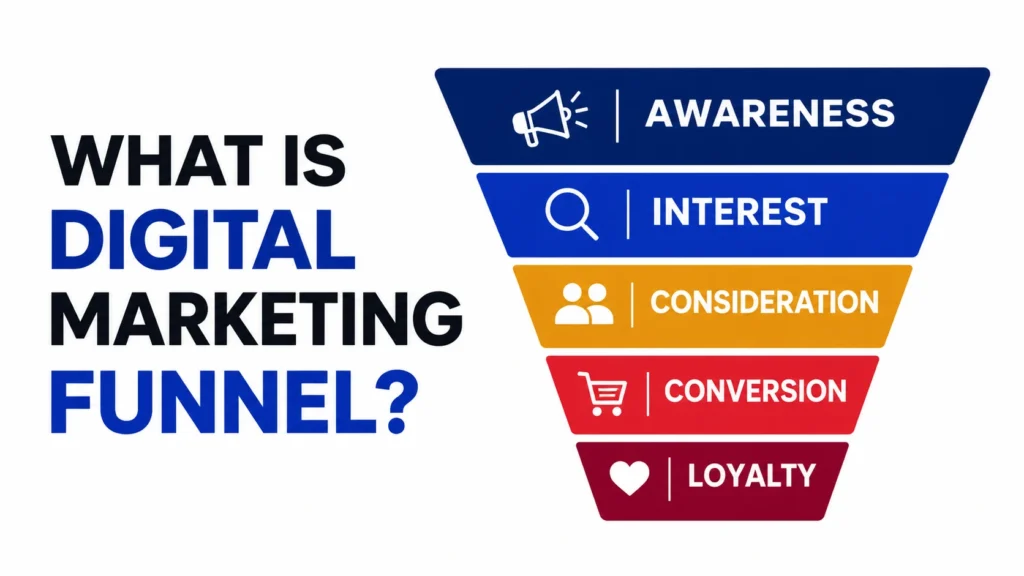
A digital marketing funnel is a strategic framework that represents the stages a potential customer moves through when interacting with a business, from initial brand discovery to purchase and long-term customer engagement.
The traditional funnel model can be divided into five stages:
Awareness → Interest → Consideration → Conversion → Retention
Each stage represents a different level of customer awareness, engagement and purchase intent.
For example, consider a person searching Google for
information about improving a website’s organic traffic. They discover an SEO
article, explore additional resources, review a digital marketing service and
eventually submit an enquiry.
This sequence illustrates how different marketing activities
can contribute to a customer’s decision-making process.
However, customer journeys are not always linear.
Individuals may enter the funnel through different channels, revisit previous
stages or interact with multiple touchpoints before making a purchase.
Therefore, marketers should treat the funnel as a strategic
model for understanding customer behaviour rather than a fixed sequence that
every customer follows.
Why Is a Digital Marketing Funnel Important?
Generating website traffic does not automatically translate into business growth. A website may receive thousands of visitors while producing very few enquiries or sales.
This difference highlights the importance of evaluating the complete customer journey.
A properly structured marketing funnel helps businesses identify weaknesses between customer acquisition, engagement and conversion.
Its strategic benefits include:
- Improved audience targeting: Helps marketers understand the needs and interests of different audience segments.
- More relevant content: Connects content formats and messages with customer intent.
- Better conversion opportunities: Identifies barriers that prevent visitors from taking meaningful actions.
- Efficient marketing investment: Helps allocate resources to channels and activities that contribute to business objectives.
- Stronger customer relationships: Extends marketing efforts beyond the initial purchase through retention and engagement strategies.
The Five Stages of a Digital Marketing Funnel
Understanding the individual stages is essential for
developing a marketing strategy that addresses customer needs at different
points in the buying journey.
1. Awareness: Building Brand Discovery
Awareness represents the initial stage of the funnel. At
this point, potential customers discover a business, product or service, often
through search engines, social media, advertisements or recommendations.
The primary objective is to attract relevant attention and
introduce the brand to an appropriate audience.
For example, a business providing SEO services might attract
potential customers through an article titled “Why Is My Website Not
Getting Organic Traffic?”
The visitor may not be actively searching for an SEO
provider. Their immediate requirement is to understand a problem.
By publishing relevant educational content, the business
creates an opportunity to introduce its expertise.
Effective awareness-stage marketing activities include:
- Search
engine optimized blog articles. - Educational
social media content. - Instagram
Reels and YouTube videos. - LinkedIn
posts and industry insights. - Paid
search and display advertising. - Informative
guides and infographics. - Public
relations and referral activities.
Important performance indicators:
Organic impressions, website sessions, reach, brand
awareness, search visibility and relevant audience growth.
2. Interest: Developing Audience Engagement
At the interest stage, potential customers have become aware
of a brand and begin exploring its information, products or services.
The objective is to encourage further engagement by
providing relevant information and demonstrating the value of the business.
For example, a visitor who discovers an article about
organic traffic may subsequently explore an SEO checklist, read another
educational article or subscribe to an email newsletter.
These interactions indicate that the individual is
interested in learning more.
Effective interest-stage marketing activities include:
- Detailed
educational articles. - Email
newsletters. - Step-by-step
tutorials. - Downloadable
resources. - Informative
social media carousels. - Webinars
and educational videos. - Related
article recommendations.
At this stage, content should provide additional value
rather than immediately pushing a sales message.
Important performance indicators:
Engaged sessions, returning visitors, newsletter
subscriptions, content interactions, pages viewed and resource downloads.
3. Consideration: Establishing Trust and Evaluating
Solutions
The consideration stage involves evaluating available
solutions.
Potential customers understand their requirements and begin
comparing businesses, products, service providers or alternative approaches.
At this point, trust, credibility and differentiation become
important factors in decision-making.
For example, a business owner considering SEO services may
compare different providers based on their experience, service offerings,
working process, pricing and previous projects.
Marketers should develop content that addresses these
evaluation requirements.
Effective consideration-stage marketing activities
include:
- Detailed
service pages. - Genuine
customer testimonials. - Verified
case studies. - Product
and service comparisons. - Frequently
asked questions. - Demonstrations
and consultations. - Detailed
project portfolios.
The objective is to reduce uncertainty and provide
sufficient information for an informed decision.
A clear explanation of service deliverables, processes and
limitations can be more valuable than broad promotional claims.
Important performance indicators:
Service-page engagement, case-study visits, consultation
requests, qualified leads and enquiry quality.
4. Conversion: Encouraging Meaningful Customer Action
Conversion occurs when a potential customer completes a
predefined action that contributes to a business objective.
Although conversion is frequently associated with purchases,
it can represent several actions depending on the business model.
Examples include:
- Submitting
an enquiry form. - Booking
a consultation. - Requesting
a quotation. - Completing
an online purchase. - Registering
for a service. - Making
a telephone enquiry. - Sending
a business enquiry through WhatsApp.
A successful conversion strategy requires a clear value
proposition, an accessible user experience and an appropriate call to action.
For example, a digital marketing consultant may use a
landing page that explains the service, identifies the target audience,
presents the working process and provides a consultation booking option.
Effective conversion-stage marketing activities include:
- Optimized
landing pages. - Clear
calls to action (CTAs). - Simple
enquiry forms. - Transparent
service information. - Relevant
offers and consultations. - Conversion
tracking. - Appropriate
follow-up communication.
Important performance indicators:
Conversion rate, qualified enquiries, completed purchases,
cost per acquisition and revenue.
5. Retention: Developing Long-Term Customer Relationships
Customer acquisition should not be considered the final
objective of digital marketing.
Retention focuses on maintaining relationships with existing
customers, encouraging repeat purchases and improving long-term customer value.
Businesses can support retention through consistent
communication, relevant information, customer support and personalized
engagement.
For example, an online service provider may send useful
educational emails, provide regular service updates and follow up with
customers to understand their experience.
Effective retention-stage marketing activities include:
- Email
marketing automation. - Customer
support communication. - Educational
resources. - Loyalty
and referral programmes. - Product
and service updates. - Personalized
recommendations. - Customer
feedback and review requests.
Satisfied customers may renew subscriptions, purchase
additional services, recommend a business or become advocates for the brand.
Important performance indicators:
Customer retention rate, repeat purchase rate, renewal rate,
customer lifetime value, customer satisfaction and referrals.
What Content Should Marketers Create at Each Funnel Stage?
Content marketing should be aligned with audience intent rather than treated as an independent publishing activity.
Each content format should serve a specific purpose within the customer journey.
| Funnel Stage | Audience Requirement | Suitable Content |
|---|---|---|
| Awareness | Understand a problem | Blogs, Reels, educational videos |
| Interest | Explore possible solutions | Tutorials, newsletters, guides |
| Consideration | Evaluate available options | Case studies, testimonials, comparisons |
| Conversion | Take a specific action | Landing pages, offers, consultations |
| Retention | Maintain the relationship | Email updates, support resources, loyalty content |
For example, an educational blog can introduce a problem, an internal link can direct visitors to a detailed guide, and a relevant service page can provide an opportunity to submit an enquiry.
The objective is to make the next step relevant to the visitor’s current level of interest.
How SEO Supports the Digital Marketing Funnel
Search engine optimization contributes to multiple stages of the marketing funnel by connecting website content with the information people are actively searching for.
The relationship between search intent and funnel stages is particularly important.
Consider the following keyword examples:
Awareness:
- What is search engine optimization?
- Why is my website not getting traffic?
Interest:
- How to improve website rankings.
- SEO checklist for small businesses.
Consideration:
- SEO services for small businesses.
- SEO agency comparison.
Conversion:
- Hire an SEO consultant.
- SEO consultant near me.
These searches demonstrate different levels of information requirements and purchase intent.
A comprehensive SEO strategy should therefore consider more than keyword search volume. It should evaluate search intent, topical relevance, content quality and the next action a visitor should take.
Keyword research tools such as Semrush can support keyword discovery, competitor analysis and opportunity identification.
Internal linking is also important because it connects related information and helps visitors discover relevant pages.
For example, an educational article about keyword research can link to a more detailed SEO guide and then to an appropriate SEO service page.
How Social Media Marketing Supports the Funnel
Social media platforms provide opportunities to attract
attention, develop engagement, demonstrate expertise and maintain communication
with potential customers.
However, effective social media marketing requires more than
publishing individual posts without a defined objective.
Consider a connected social media content sequence:
Awareness: An Instagram Reel introduces a common
business problem.
Interest: An educational carousel explains possible
solutions.
Consideration: A detailed project example
demonstrates the strategy and its implementation.
Conversion: A clear call to action encourages
interested users to submit an enquiry.
Social media can also contribute to retention through
customer communication, updates, community engagement and educational content.
The important consideration is to align social media
activities with broader business objectives and the different stages of the
customer journey.
How to Build a Digital Marketing Funnel: A Practical Framework
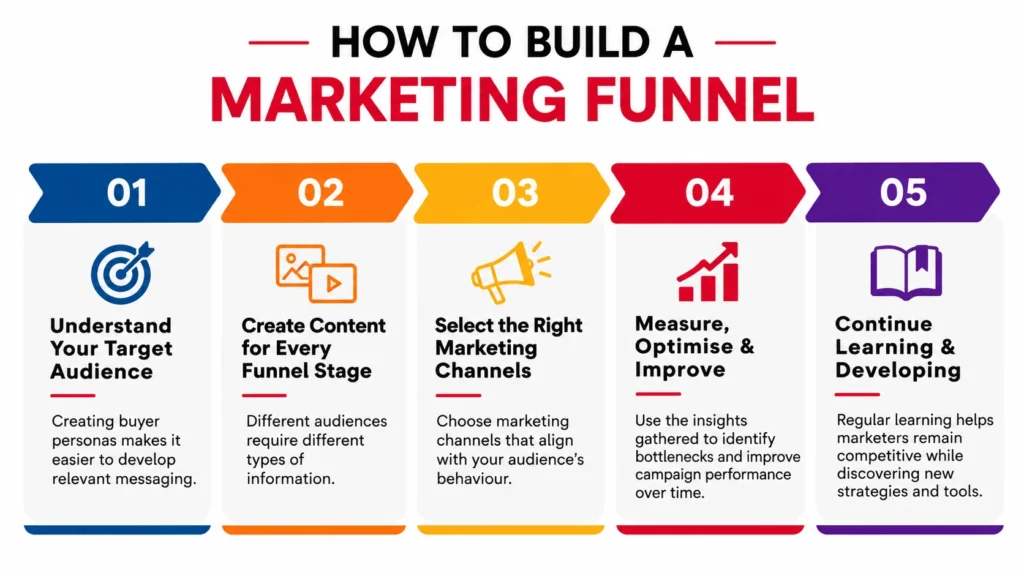
Developing an effective marketing funnel requires a clear
understanding of the business, its target audience and the actions it expects
customers to take.
The following framework provides a structured starting
point.
Step 1: Define the Target Audience
Identify the specific audience the business wants to
attract.
Consider demographic characteristics, customer requirements,
purchasing behaviour, interests and common problems.
A clearly defined audience makes it easier to select
suitable marketing channels and develop relevant messaging.
Step 2: Identify Customer Problems and Search Intent
Research the questions, concerns and challenges potential
customers experience.
Analyse relevant search queries, customer feedback,
competitor content and enquiries.
Use these insights to understand the information customers
require before making a decision.
Step 3: Develop Stage-Specific Content
Create content that addresses different customer
requirements.
Educational articles may support awareness, detailed guides
can develop interest, and case studies can help establish credibility during
consideration.
Every content asset should have a defined objective.
Step 4: Select Appropriate Marketing Channels
Choose channels according to the audience, business model
and campaign objectives.
These may include:
- Organic
search.
- Paid
search advertising.
- Social
media.
- Email
marketing.
- Content
marketing.
- Referral
marketing.
A business does not necessarily need to use every available
channel. Channel selection should be based on relevance and available
resources.
Step 5: Create Relevant Conversion Opportunities
Develop appropriate landing pages, enquiry forms, booking
options and calls to action.
Ensure visitors understand what the business offers and what
action they can take next.
Reduce unnecessary steps that may create friction during
conversion.
Step 6: Implement Analytics and Conversion Tracking
Use appropriate measurement tools to evaluate marketing
performance.
Google Analytics 4 can help analyse website interactions and
user activity, while Google Tag Manager can support the implementation and
management of tracking tags.
Conversion tracking should be configured according to the
business’s actual objectives.
Step 7: Analyse Performance and Optimize
Review funnel performance regularly.
Identify stages where audience engagement decreases or where
potential customers fail to complete the intended action.
Use these findings to improve content, targeting, landing
pages and communication.
Measuring Digital Marketing Funnel Performance
A digital marketing funnel should be measured at every stage to understand how effectively potential customers move from discovering a brand to becoming loyal customers.
Marketers should select key performance indicators (KPIs) that match the objective of each funnel stage.
|
Funnel Stage |
Important KPIs |
|---|---|
|
Awareness |
Impressions, reach, organic traffic |
|
Interest |
Engagement rate, returning visitors, email subscriptions |
|
Consideration |
Service-page visits, qualified leads, case-study engagement |
|
Conversion |
Conversion rate, sales, cost per acquisition |
|
Retention |
Repeat purchases, customer retention rate, customer lifetime value |
Understanding Marketing Performance
Not all metrics represent business success. For example, website traffic and social media impressions measure audience activity, but they do not necessarily indicate revenue or customer growth.
Marketers should evaluate both engagement metrics and business outcome metrics. This helps identify which marketing activities contribute to meaningful results and where improvements are required.
Marketers can use Google Analytics 4 to understand website traffic, user behaviour and conversion performance.
Common Digital Marketing Funnel Mistakes
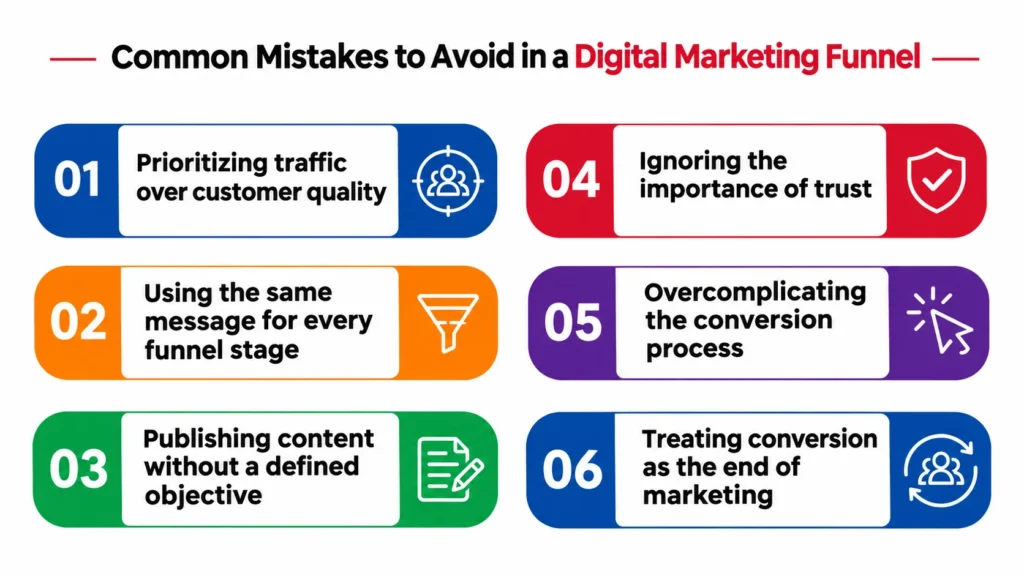
Even well-planned marketing strategies can experience performance problems when the customer journey is not properly understood.
Several common mistakes deserve attention.
1. Prioritizing traffic over customer quality
High website traffic does not necessarily indicate successful marketing. Businesses should evaluate whether visitors match their target audience and demonstrate meaningful interest.
2. Using the same message for every funnel stage
A first-time visitor and a potential customer comparing service providers have different information requirements. Marketing communication should reflect these differences.
3. Publishing content without a defined objective
Content should contribute to a specific marketing purpose, whether that involves discovery, education, trust-building or conversion.
4. Ignoring the importance of trust
Potential customers often require evidence before making a decision. Transparent service information, genuine testimonials and verified case studies can help establish credibility.
5. Overcomplicating the conversion process
Unnecessary form fields, unclear calls to action and confusing navigation can create barriers to conversion.
6. Treating conversion as the end of marketing
Customer engagement should continue after a purchase through appropriate support, communication and retention activities.
How to Improve a Digital Marketing Funnel Over Time
A digital marketing funnel should be treated as an ongoing
optimization process rather than a one-time implementation.
Performance analysis helps marketers identify where
improvements may be necessary.
For example, a website may attract relevant organic traffic
but generate very few enquiries. In this situation, marketers should
investigate the service page, user experience, messaging and conversion process
before investing additional resources in traffic acquisition.
A structured optimization cycle can be represented as:
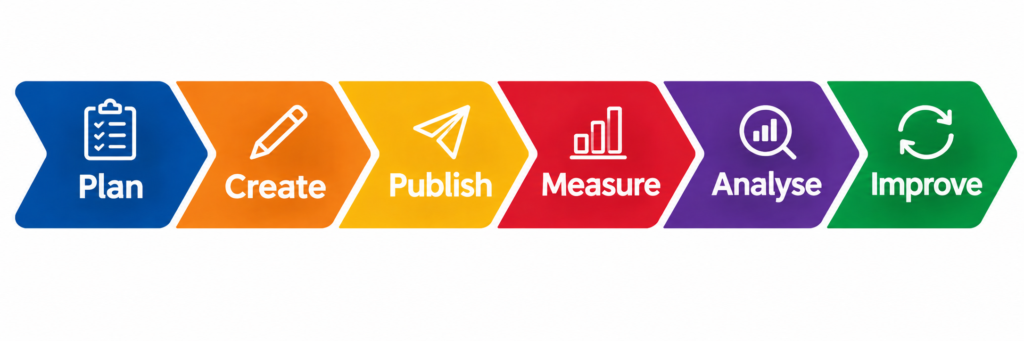
1. Plan
Set clear marketing objectives, identify the target audience and define the expected customer journey.
2. Create
Develop relevant content, landing pages and campaigns for each funnel stage.
3. Publish
Distribute content through suitable channels, such as search engines, social media, email and paid advertising.
4. Measure
Track important KPIs using tools such as Google Analytics 4 and Google Tag Manager.
5. Analyse
Identify which channels and content generate engagement, qualified leads and conversions. Find where potential customers leave the funnel.
6. Improve
Optimise targeting, content, landing pages and calls to action based on performance data. Test changes and measure their impact.
Conclusion: Building a Successful Digital Marketing Funnel
A digital marketing funnel provides businesses with a structured approach to attracting potential customers, developing relationships and generating conversions. By understanding the five stages—Awareness, Interest, Consideration, Conversion and Retention—marketers can create more relevant experiences throughout the customer journey.
An effective funnel requires more than generating website traffic. It involves understanding customer needs, developing valuable content, selecting appropriate marketing channels and measuring performance at every stage.
Businesses that continuously analyse and optimise their marketing funnels can identify opportunities, improve conversion rates and build stronger customer relationships.
Ultimately, a successful digital marketing funnel connects the right audience with the right message at the right time.