
How to Build a Content Strategy for a Brand?
You don’t need more content.
You need better content with a reason behind it.
Think about the number of brands you see posting every day. Instagram reels, LinkedIn posts, blogs, carousels, videos, offers, memes—the internet is full of content.
But here’s the interesting part:
Most brands are not struggling because they don’t create enough content. They’re struggling because they don’t know what their content is supposed to achieve.
They post because it’s Monday.
They create a Reel because everyone else is creating Reels.
They write a blog because someone told them blogging is good for SEO.
And after months of posting, they look at the numbers and ask:
“Why isn’t any of this turning into business?”
That’s where a content strategy comes in.
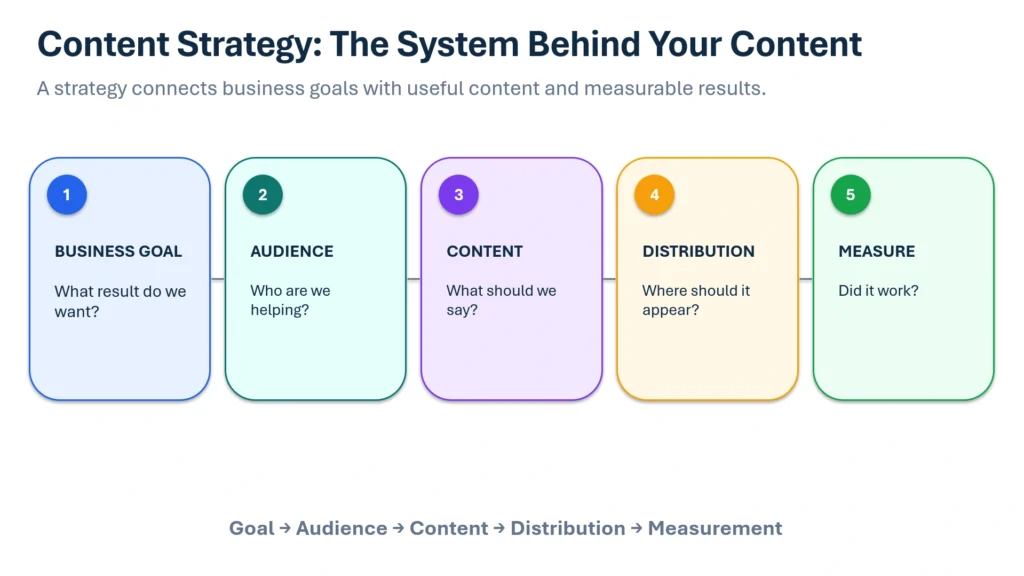
A good content strategy gives your brand a clear answer to five simple questions:
Who are we creating content for?
What do they need?
What should we talk about?
Where should we publish it?
And what result are we trying to achieve?
In this guide, let’s break down how to build a content strategy for a brand—without making it unnecessarily complicated.
First, What Exactly Is a Content Strategy?
Let’s make this simple.
A content strategy is the plan behind your content.
It decides what your brand should create, who it should create it for, where it should be published, and how it should contribute to your marketing goals.
It’s much bigger than a content calendar.
A calendar tells you:
“Post an Instagram carousel on Tuesday.”
A strategy tells you:
“We’re creating educational Instagram content because our target audience doesn’t understand how our product solves their problem. The goal is to build trust and eventually generate enquiries.”
See the difference?
One tells you what to post.
The other tells you why you’re posting it.
Your strategy should connect:
Business goal → Audience → Problem → Content → Distribution → Measurement → Improvement
If one of these pieces is missing, your content can easily become a collection of random posts.
Why Do Brands Need a Content Strategy?
Imagine opening Instagram tomorrow morning and deciding:
“What should I post today?”
You search for a trending audio.
Then you see a competitor posting an infographic.
So you make an infographic.
The next day, you share a promotional offer.
A few days later, you publish a motivational quote.
Nothing is necessarily wrong with any individual post.
The problem is that there is no connection between them.
This is what happens when a brand creates content without a strategy.
A proper strategy gives your content direction. It also helps you understand your audience, build authority, use your time more efficiently, and measure whether your efforts are actually working.
So, how do you build one?
Let’s start from the beginning.
1. Start With the Business Goal
This is where most content strategies should begin.
Not with Instagram.
Not with Canva.
Not with “What should I post today?”
Start with the business.
Ask:
“What do we want this content to help us achieve?”
Maybe you’re a new brand trying to become known.
Maybe you want more website traffic.
Maybe you want more enquiries.
Maybe you’re trying to generate leads.
Maybe you’re launching a new product.
Maybe you want to establish yourself as an expert in your industry.
These are very different goals, and they require different content.
For example, imagine you’re a digital marketing consultant.
Your goal isn’t simply:
“I want more Instagram followers.”
A better business goal might be:
“I want to generate qualified enquiries from small-business owners.”
Now your content has a direction.
You could create:
- Educational blog posts
- SEO guides
- Case studies
- Marketing checklists
- Problem-solving videos
- Website audits
- Practical marketing tips
Your content is no longer created just to fill your social media calendar.
It’s supporting a business objective.
That’s the first shift you need to make:
Don’t ask what content you can create. Ask what business problem your content should help solve.
2. Get Clear About Who You're Talking To
Here’s a simple test.
Imagine you’re standing in a room with 100 people.
You have one minute to explain your product.
Would you speak to all 100 people in exactly the same way?
Probably not.
Your content works the same way.
You need to know who you’re talking to.
For example, saying:
“Our audience is people interested in digital marketing.”
isn’t very useful.
That’s far too broad.
Instead:
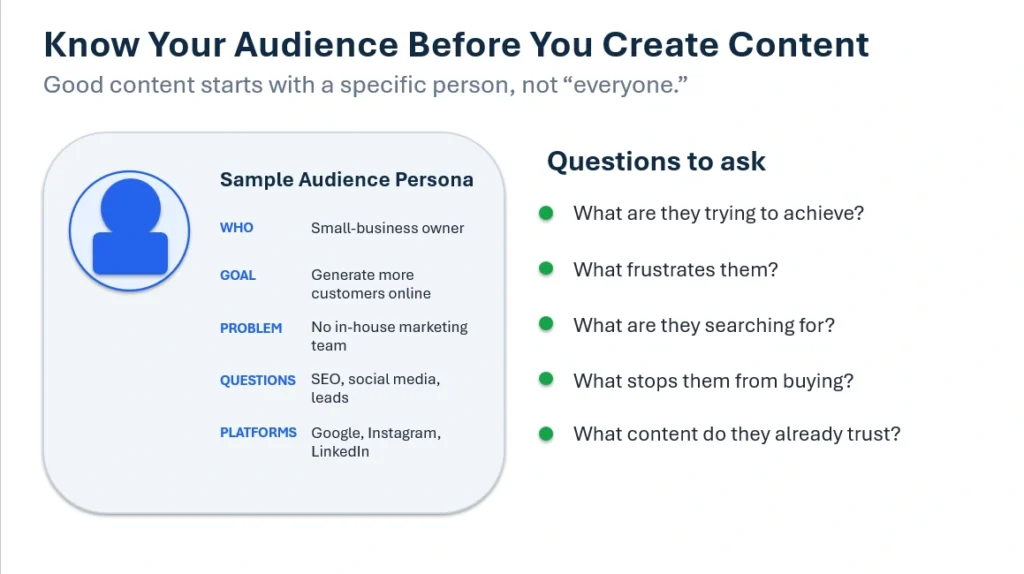
“Our target audience is small-business owners who want more customers through digital marketing but don’t have an in-house marketing team.”
Now things become easier.
You can start asking:
- What are their biggest problems?
- What are they trying to achieve?
- What do they already know?
- What confuses them?
- Which platforms do they use?
- What questions do they ask?
- What stops them from buying?
The more clearly you understand your audience, the easier it becomes to create content that feels relevant.
And that’s exactly what you want.
You want someone to read your headline and think:
“This is exactly my problem.”
3. Find Their Problems Before Finding Your Topics
Here’s one of my favourite ways to generate content ideas:
Stop thinking about topics. Start thinking about problems.
People don’t usually search Google because they want to read a random blog.
They search because they want an answer.
A business owner might search:
“Why isn’t my website getting traffic?”
Or:
“Why am I getting Instagram views but no customers?”
Or:
“How much should I spend on Google Ads?”
Those questions are not just questions.
They’re content opportunities.
Let’s say your audience has this problem:
“My website gets visitors, but nobody contacts me.”
You could turn that one problem into several pieces of content:
- Why Your Website Gets Traffic but No Leads
- 7 Landing Page Mistakes That Reduce Conversions
- How to Create a Landing Page That Converts
- Why Visitors Leave Your Website Without Contacting You
Now you have a content system based on something your audience actually cares about.
That’s far more powerful than sitting in front of Canva trying to invent “10 Instagram post ideas.”
4. Look at What Your Competitors Are Doing
You don’t need to copy your competitors.
But you absolutely should study them.
Look at:
- What topics they cover
- Which posts get engagement
- What keywords they target
- Which formats they use
- What questions they answer
- What they aren’t answering
The last one is particularly important.
Look for content gaps.
Suppose three competitors have written:
“10 SEO Tips for Beginners.”
Instead of writing the fourth version of exactly the same article, ask:
“What are they missing?”
Maybe you create:
“10 SEO Mistakes Beginners Make—and How to Fix Them.”
Or perhaps:
“A Beginner’s SEO Checklist for a New Website.”
The goal isn’t to become a better copycat.
The goal is to find an opportunity to provide more useful, clearer, or more practical information.
5. Choose Your Content Pillars
Now we know:
- What the business wants
- Who we’re talking to
- What problems they have
- What competitors are already covering
Next comes something very useful:
Content pillars.
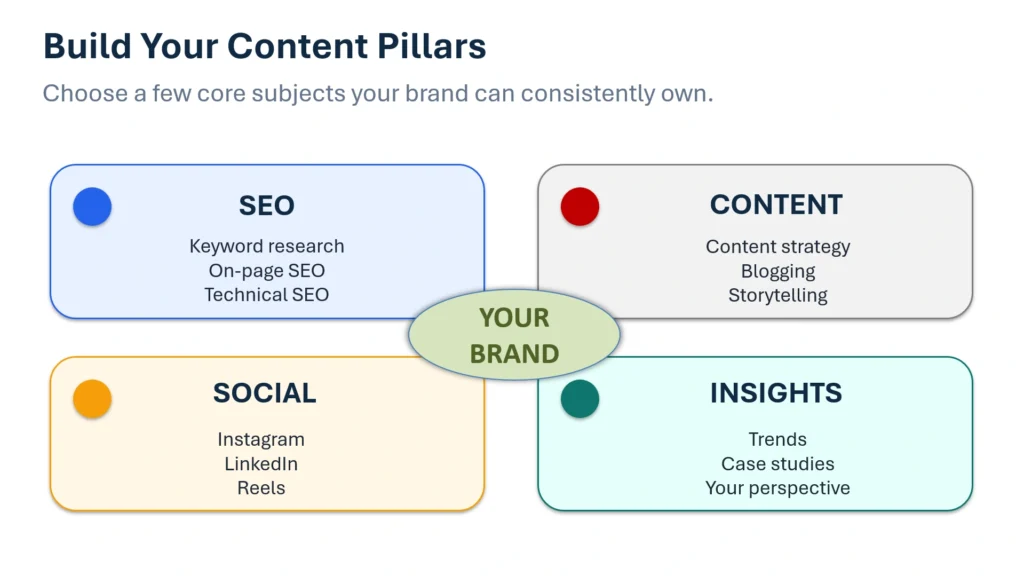
Content pillars are the main subjects your brand consistently talks about.
Think of them as the “big buckets” into which your content ideas will fall.
For a digital marketing personal brand, you might choose:
SEO
You could talk about:
- Keyword research
- On-page SEO
- Technical SEO
- Internal linking
- Google Search Console
- Common SEO mistakes
Content Marketing
You could cover:
- Content strategy
- Blogging
- Storytelling
- Content planning
- Content distribution
Social Media Marketing
You could discuss:
- Instagram marketing
- LinkedIn marketing
- Reels
- Engagement
- Social media analytics
Digital Marketing Insights
You could share:
- Marketing trends
- Campaign analysis
- Case studies
- Lessons from real projects
- Your own opinions and observations
Now, when you need a new content idea, you don’t have to start from zero.
You simply ask:
“What can I create around this pillar?”
That’s how consistency becomes easier.
6. Add SEO and Search Intent to the Strategy
If your brand depends on Google for visibility, keyword research should be part of your content strategy.
But don’t make the mistake of thinking:
“High search volume = good keyword.”
Not necessarily.
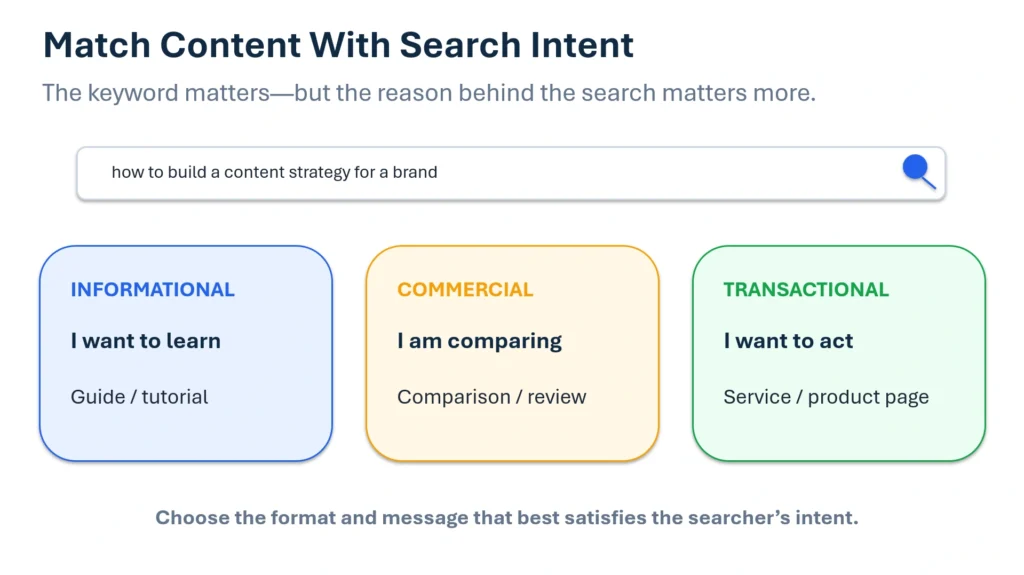
You also need to understand search intent.
Consider these two searches:
“What is SEO?”
and
“SEO agency near me”
The first person is probably learning.
The second person may be looking for a service.
They’re at completely different stages of the buying journey.
Your content needs to match that intent.
For a blog about content strategy, for example:
Primary keyword:
Content strategy
Secondary keywords:
- Content strategy framework
- Content planning
- Content marketing strategy
- Content strategy for brands
- Social media content strategy
Long-tail keyword:
How to build a content strategy for a brand
The goal isn’t to force these keywords into every paragraph.
The goal is to understand what people are searching for and create the best answer for them.
7. Choose the Right Content Format
Not every idea needs to become a 2,000-word blog.
Some ideas are better as videos.
Some work better as carousels.
Some deserve a detailed guide.
Others might be perfect for LinkedIn.
You could use:
- Blog posts
- Reels
- Short-form videos
- Carousels
- Infographics
- Case studies
- Tutorials
- Newsletters
- Podcasts
- Webinars
- Checklists
But don’t try to do everything.
That’s another common mistake.
Choose formats based on:
Where your audience spends time + what format communicates the idea best + what you can produce consistently.
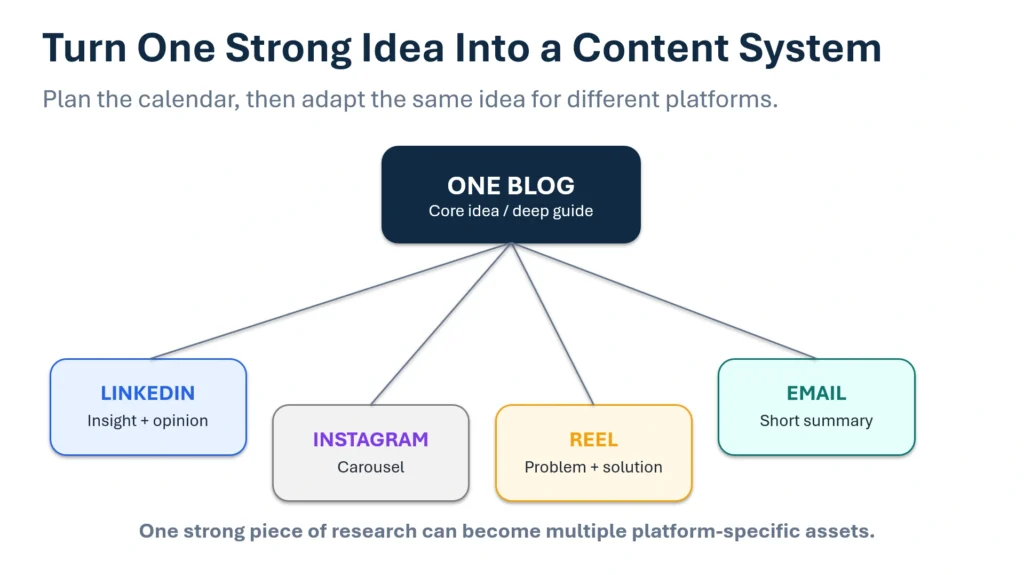
For example, one blog post could become:
Blog → LinkedIn post → Instagram carousel → Reel → Email
That’s called content repurposing.
Instead of creating five completely different ideas, you’re getting more value from one strong idea.
8. Build a Content Calendar
Now we’re getting to the part most people think of when they hear “content strategy.”
The content calendar.
But notice something:
The calendar comes after the strategy—not before it.
Your calendar can be as simple as:
| Day | Content | Format | Platform | Goal |
|---|---|---|---|---|
| Monday | SEO Basics | Blog | Website | Traffic |
| Tuesday | SEO Tip | Carousel | Awareness | |
| Wednesday | SEO Mistake | Reel | Engagement | |
| Thursday | SEO Insight | Post | Authority | |
| Friday | SEO Checklist | Newsletter | Leads |
It doesn’t need to look complicated.
The purpose is simply to remove the daily question:
“What should I post today?”
Instead, you already know what you’re creating, where it is going, and why you’re creating it.
9. Don't Turn Your Brand Into a Sales Channel
Here’s something worth remembering:
People don’t follow brands because they want to be sold to every day.
Imagine following a business and every post says:
“Buy now.”
“Limited offer.”
“Contact us.”
“Book today.”
“Don’t miss this deal.”
Eventually, you stop paying attention.
Your content needs variety.
Teach
Give people useful knowledge.
“How to Perform Keyword Research for a New Website”
Solve
Help them overcome a specific problem.
“Why Your Website Isn’t Ranking on Google”
Share your perspective
Show people how you think.
“Why I Don’t Recommend Chasing Every Marketing Trend”
Show proof
Lorem ipsum dolor sit amet, Demonstrate results and experiences.
“How We Increased Website Enquiries by 40%”
Promote
Then, when appropriate, talk about your product or service.
“Here’s What’s Included in Our SEO Audit.”
The exact mix depends on the business.
But the principle is simple:
Give people a reason to trust you before giving them a reason to buy from you.
10. Give Your Brand a Recognizable Voice
Imagine reading a LinkedIn post without seeing the person’s name.
After a while, you should be able to think:
“I know who wrote this.”
That’s the power of a consistent brand voice.
Decide how your brand should sound.
Maybe it’s:
- Practical
- Friendly
- Direct
- Professional
- Data-driven
- Conversational
You don’t have to sound identical on every platform.
Your Instagram content can be more casual.
Your website can be more professional.
Your LinkedIn content can be more opinion-driven.
But the personality behind the communication should remain recognizable.
Consistency creates familiarity, and familiarity builds trust.
11. Focus on Quality, Not Just Consistency
“Post consistently.”
You’ve probably heard that advice a thousand times.
It’s good advice—but it’s incomplete.
Consistency doesn’t make bad content good.
You could publish every day and still accomplish nothing.
Before publishing something, ask:
- Does this actually answer a question?
- Is the information accurate?
- Is it easy to understand?
- Does it provide something useful?
- Are the examples relevant?
- Does it have a clear point?
- Am I saying something original or useful?
- Would I personally find this worth reading?
And here’s an important one:
Would someone save this, share it, or come back to it later?
If the answer is no, the content probably needs more work.
Don’t add another 500 words just to make a blog longer.
Useful beats long.
12. Creating Content Isn't Enough—Distribute It
You’ve spent three hours writing a fantastic blog.
You publish it.
Then you wait.
Nothing happens.
This is where many content creators stop.
But publishing is only one part of the process.
Your content needs distribution.
A blog post could be promoted through:
- WhatsApp communities
- Relevant online communities
But don’t simply copy and paste the same thing everywhere.
Change the presentation.
For example:
Blog:
Detailed explanation.
LinkedIn:
Your biggest insight + your opinion.
Instagram carousel:
Five key lessons.
Reel:
One problem + one solution.
Email:
Short summary + link to the full article.
One strong idea can therefore become an entire content ecosystem.
13. Always Give People a Next Step
You’ve got someone’s attention.
Now what?
Don’t leave them wondering what to do next.
Give them a logical next step.
If your goal is awareness:
Follow for more practical digital marketing insights.
If you want engagement:
What’s the biggest SEO problem you’re facing right now?
If you’re generating leads:
Download our free SEO checklist.
If you’re selling a service:
Want help improving your website? Book a consultation.
If you’re writing a blog:
Want to learn more about SEO? Continue with our complete guide to on- page SEO.
The CTA should make sense.
Don’t throw a sales pitch at someone who just finished reading an introductory educational article.
Context matters.
14. Measure What Actually Matters
Here’s where you find out whether your content strategy is working.
And no, the answer isn’t always:
“How many followers did we gain?”
Followers can be useful.
But they aren’t the business.
Suppose Brand A has:
100,000 followers → 2 enquiries
Brand B has:
5,000 relevant followers → 50 enquiries
Which brand would you rather own?
Exactly.
Your metrics should match your objective.
If your goal is awareness
Look at:
- Reach
- Impressions
- Video views
- Brand searches
If your goal is engagement
Look at:
- Comments
- Shares
- Saves
- Watch time
- Engagement rate
If your goal is website growth
Look at:
- Organic traffic
- Search impressions
- Click-through rate
- Page engagement
If your goal is lead generation
Look at:
- Enquiries
- Form submissions
- Email signups
- Conversion rate
If your goal is sales
Look at:
- Revenue
- Sales generated
- Customer acquisition cost
- Return on marketing investment
The right metric is the one that helps you understand whether you’re moving closer to your actual business goal.
15. Your Strategy Should Change
One final thing:
Your content strategy is not a document you create once and forget about.
Markets change.
Audiences change.
Platforms change.
Your business changes.
And your own understanding improves.
So review your content regularly.
Ask:
What worked?
Which topics generated traffic, engagement, leads, or sales?
What didn't work?
Which content consumed time but produced almost nothing?
What should we create more of?
Look for patterns.
What should we stop doing?
Be willing to cut activities that aren’t contributing to the goal.
For example, if your educational SEO articles consistently bring qualified visitors while random promotional posts get almost no meaningful response, that’s useful information.
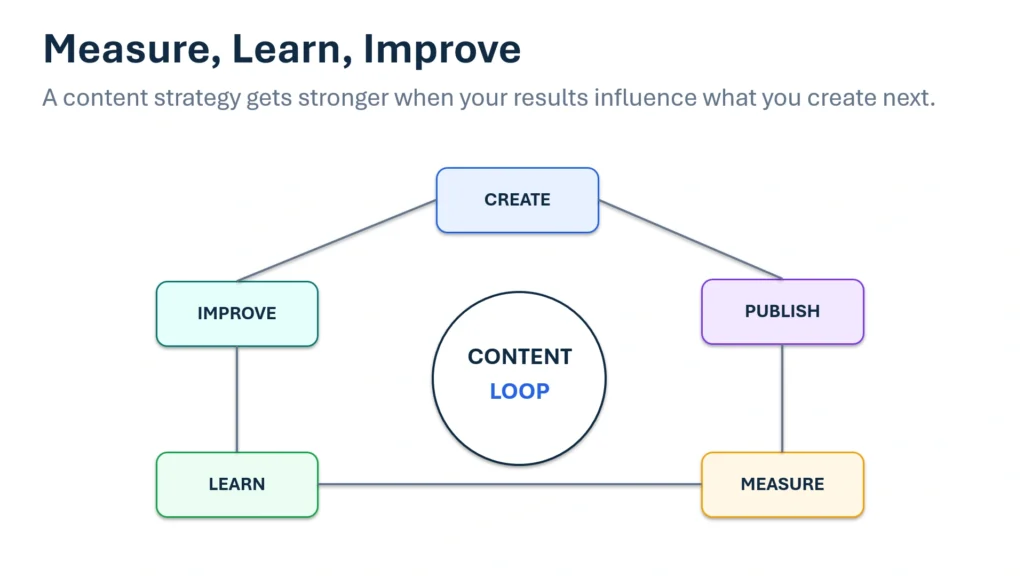
Your analytics should influence what you create next.
That’s how a content strategy becomes better over time.
The Simple Content Strategy Formula
If everything above feels like a lot, remember this:
1. Goal
What do we want to achieve?
↓
2. Audience
Who are we trying to reach?
↓
3. Problems
What are they struggling with?
↓
4. Content Pillars
What topics should we consistently talk about?
↓
5. Keywords
What are they searching for?
↓
6. Formats
What’s the best way to communicate the idea?
↓
7. Calendar
When and where will we publish?
↓
8. Distribution
How will we get the content in front of people?
↓
9. CTA
What should they do next?
↓
10. Measurement
Did it work?
↓
11. Optimization
What should we change?
And then the cycle starts again.
Plan → Create → Publish → Measure → Improve.
Final Thoughts
A content strategy isn’t about filling your Instagram feed.
It isn’t about publishing three blog posts every week just because someone told you that consistency is important.
And it definitely isn’t about stuffing keywords into every paragraph.
A good content strategy is about making intentional decisions.
You know who you’re talking to.
You understand what they care about.
You know what your business wants to achieve.
You create content that connects those two things.
Before you publish your next piece of content, ask yourself five questions:
Who is this for?
What problem does it solve?
Why should they care?
What business goal does it support?
How will I know whether it worked?
If you can’t answer those questions, stop and rethink the content.
Because the goal isn’t to create more content.
The goal is to create content that deserves attention.
And when every blog post, video, social media post, and email has a clear purpose, you’re no longer just posting content.
You’re building a brand.